
AI Is Your Best Intern
🎧 Listen to the audio version: on Spotify LISTEN
We talk a lot about AI replacing jobs. What we should be talking about is AI replacing tasks so humans can do what humans do best.
At Nebula Academy, we've been experimenting with AI since its earliest iterations. As the technology evolved, so did how we use it. Over the last few years, we've tested and refined our approach across marketing, grant writing, and software engineering. And what we've discovered is this: AI is like hiring the best intern you've ever had. Brilliant work ethic. Takes direction well. Produces incredible output. But you still have to review everything, ask the right questions, and catch what it misses. That's not a flaw. That's the partnership.
But here's the part most people miss. The partnership only works if you understand two things at the same time: what AI is genuinely good at, and where it breaks down. The teams getting the most out of AI aren't the ones using it the most. They're the ones who understand it the best, who know their own field deeply, and who use that combination to iterate.
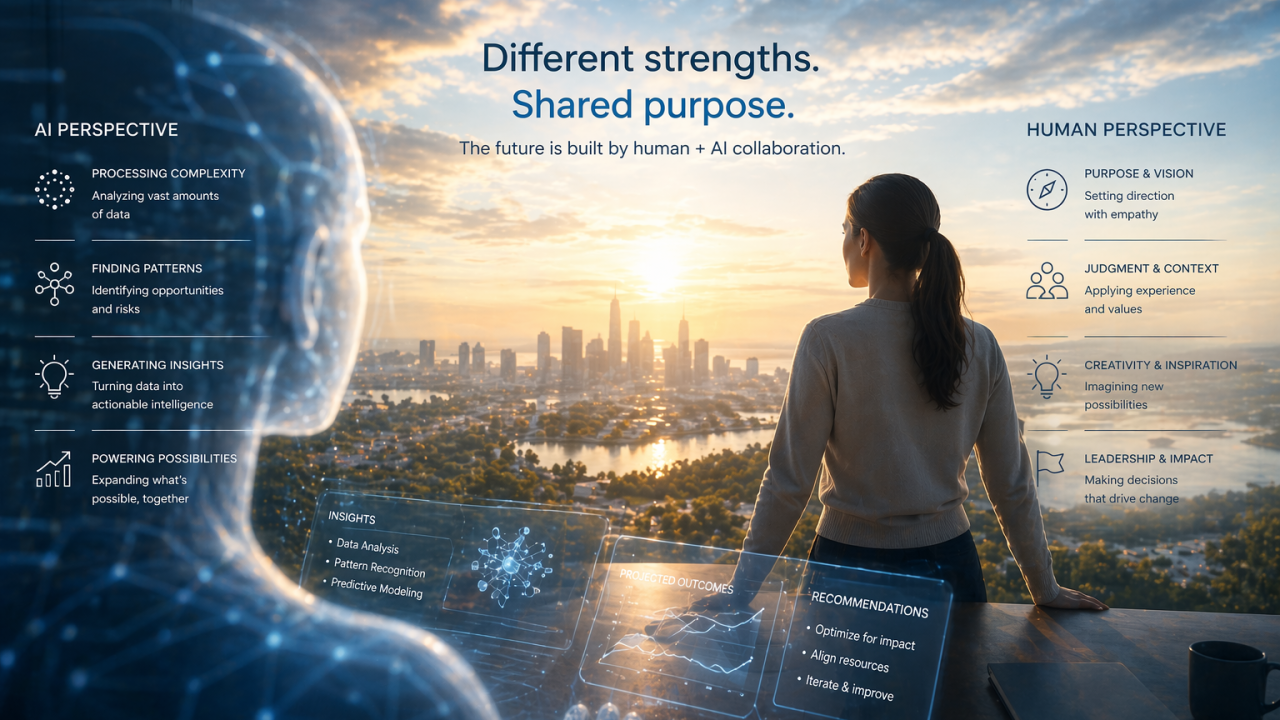
AI gives you leverage. Your expertise gives that leverage a direction.
Let me show you what I mean.
Marketing: From Production to Conversation
We produce a lot of content. Video scripts, blog articles, podcast materials, event content. All of it lives somewhere. What we realized is that we could feed all of that into Claude through a project, and suddenly we had a partner who understood our voice, our mission, everything we stand for.
That changed everything. Instead of our team starting from scratch on each script, they now start from a conversation. Claude pulls from our existing content, our brand voice, our past work. Our people aren't grinding through writing anymore. They're reviewing, refining, making it better. And here's the kicker: they stopped working late. We uncovered that some team members were staying hours past their shift trying to keep up. Now they're producing the same output in regular hours. The work got faster. The people got their lives back. What made this even more powerful was building Claude Skills around our brand.
A Skill is a reusable package of instructions, examples, and standards that Claude can load on demand. We captured our tone, our vocabulary, the way we open a script, the way we close a call to action, the things we never say. Now every person on our team who opens a conversation with Claude gets the same grounding.
The intern doesn't have to be re-trained every Monday. Brand consistency stopped being a review-stage correction and started being a starting-line default. Here's what made any of that possible: we had to understand our brand first. Claude doesn't know what your voice sounds like. We do. The Skill only works because someone on our team knows the difference between a sentence that sounds like Nebula and a sentence that sounds like every other education company on the internet.
That's the leverage point. AI gave us speed. Our understanding of who we are gave that speed a direction. Without the marketing knowledge underneath, we'd just be producing more generic content faster, which is exactly the trap we're trying to help our clients avoid. The team that knows their audience, their positioning, and their voice is the team that can train AI to protect it.
Proposal Writing and RFQs: Scale Through Smarter Thinking
Proposal writing is a numbers, and iteration game. The more you apply, the more you learn, the more you're likely to get selected. But it's also exhausting. Every RFP, every RFQ feels like starting over.
We decided to give Claude everything. Every proposal we've ever written. Every RFQ response. Our course curriculum. Our coaching frameworks. Our team building activities. Everything that makes us us. Then we had a conversation about what we were building, what we were solving for, and what made us different.
Six RFQs in four days. That's not because Claude wrote them. It's because Claude did the heavy lifting while our team did the thinking. We shifted from being writers to being reviewers. And here's what I learned: reviewing your own work when you're fresh is where the real magic happens. You catch nuances. You strengthen arguments. You make sure you're actually saying what you mean to say. That's the human work. That's the work that matters.
The speed is the headline, but it's not the lesson. Six RFQs in four days only matters if those proposals are good. They're good because our team knows what reviewers actually weigh, which differentiators land, which case studies prove the point, and where to challenge an assumption baked into the brief. Claude can't tell you any of that. It can shape language brilliantly, but it can't tell you whether you're solving the right problem for this particular buyer in this particular sector. That judgment is domain knowledge. It's pattern recognition built from years in the work. AI doesn't generate it; it amplifies it. Understanding what AI can and can't do is what lets you put it on the right side of the work, where it speeds you up, instead of the wrong side, where it puts polished language around a weak strategy.
Course Design and Learning Experiences: Smarter Iteration
We've been using AI to rethink our course content since the beginning. Blank slate curriculum concepts. Gamification challenges. New ways to structure learning sequences. All of it shaped with AI as a thinking partner. What's exciting is that we've taken everything we learned and built it into our learning management system itself.
Our instructors and course developers now have those same capabilities built into the platform. They can iterate faster. They can test new ideas without starting from zero. And the learning experience gets better because the design process gets smarter. Administrators see cleaner workflows. Instructors spend less time wrestling with structure and more time focused on what students actually need to learn. It's the same pattern we're seeing everywhere: automate the repetitive stuff, free humans up for the thinking.
This is also where understanding the field really matters. AI will happily generate curriculum all day. It will produce learning objectives, module outlines, and assessment questions on demand. But instructional design is a discipline. Knowing where learners get stuck, what produces real comprehension versus surface engagement, when to add a challenge and when to scaffold, how to sequence a concept so it actually sticks, that's earned knowledge.
Our instructors and developers iterate well because they know what good learning looks like and they can tell when AI has missed the mark. The AI accelerates the work. Their expertise is what makes sure the iteration is moving in the right direction instead of just moving fast.
Software Engineering: Speed, Memory, and the Skills Fix
Our development team rebuilt our entire learning management system from the ground up. Figma. GitHub integration. Azure infrastructure. DevOps. Security. Compliance. Testing frameworks. We built all of it with Claude as a coding partner.
The speed was remarkable. But the memory issue showed up too. Claude helped us build two specific Azure components for redundancy across Dev. Demo. Prod. Then in a later conversation, it forgot we built them. Argued with our team that they didn't exist. We had to course correct it, laugh about it, and move on. It's like hiring someone brilliant who sometimes forgets what they did yesterday.
That's exactly where Claude Skills changed the game for our team. Instead of re-explaining our architecture every time someone opened a new session, we built Skills that encode the things Claude needs to know to be a reliable contributor on our codebase. Our Azure conventions. Our DevOps pipeline patterns. Our naming standards. The components we've already built and how they connect. The security and compliance rules that are non-negotiable. Our testing approach. When a developer starts a new task, Claude loads the right Skill and shows up already grounded. Fewer hallucinated functions. Fewer arguments about whether something exists. Consistent code, written the way our team writes it, whether the human at the keyboard has been here six years or six days.
The memory problem didn't disappear. It got engineered around. Skills are how we make sure Claude has the correct information available at the moment it's needed, not what it happened to remember from a conversation three weeks ago. Pay attention to what made any of this possible. Our team knew the architecture. They knew those Azure components existed because they had built them. If they had not had that engineering depth, Claude's confident wrong answer would simply have become the answer, and we would have been chasing bugs we created ourselves.
That is the pattern with every AI limitation. You can only catch what AI gets wrong if you know enough to recognize wrong in the first place. The Skills we built only exist because humans understood our codebase, our infrastructure, our security posture, and our standards deeply enough to write them down. AI did not make our engineers less valuable. It made the depth of their knowledge more leveraged than it has ever been. The engineer who understands both the system and the tool is now doing the work of three.
Here's the thing though: humans have memory issues too. We forget things. We get tired. We miss details. AI will get better at this. And when it does, this partnership gets even stronger. The fundamentals don't change. Understanding the tool, understanding the work, and iterating intentionally between the two is what makes the difference.
Iterating on Skills: Compounding What We Learn
The biggest shift for us hasn't been any single Skill. It's been the practice of iterating on them. Every time our team catches Claude misunderstanding or forgetting, we update the Skill. Every time our marketing team refines how we talk about a new program, we update the Skill. Every time a grant reviewer gives us feedback, we update the Skill.
The lessons don't stay trapped in one person's head or one Slack thread. They get written into the Skill, and the next time anyone on the team works with Claude, they inherit that learning automatically. That's how we're excelling at product development and protecting brand consistency at the same time. Skills turn one person's hard-won insight into the whole team's starting point. Our LMS ships faster because the engineering Skills keep getting sharper. Our content reads like us because the brand Skills keep getting more precise. The product gets better and the voice stays ours, not because we're working harder, but because we're compounding what we learn every single week.
And here is the meta-point. Every Skill update is someone on our team translating their domain knowledge into something the AI can actually use. The Skill is just the artifact. The real asset is the understanding behind it, and the discipline of capturing that understanding instead of letting it stay locked in someone's head. That requires people who know AI well enough to know what to write down, and who know their craft well enough to know what's worth writing down. That intersection, the person who understands both the tool and the trade, is the most valuable role on a modern team.
That intern we hired? We're not just giving them better projects. We're writing down what works so they get smarter every time they come back to the desk.
The Real Shift: From Writer to Reviewer
What connects all of these examples is the same pattern. We didn't automate the human out of the work. We automated the human out of the grunt work so they could do the actual thinking. Your team isn't spending hours on formatting or structure or generating options. They're spending time on judgment. On nuance. On making sure what gets sent out into the world reflects who you actually are.
The judgment, the nuance, the knowing, that is not a soft skill. That is domain expertise, and it is the thing AI can't replicate. Understanding your industry, your customers, your craft, your codebase, your students, your mission, that knowledge is the multiplier. AI gives you reach. Your expertise gives that reach a target.
The teams that win the next decade will be the ones who get fluent in both, the people who understand AI's power and its limits, and who pair that fluency with deep knowledge of the field they actually work in. And here's one more thing: even this article you're reading was shaped through voice conversations with Claude on my phone. I talk. Claude listens and shapes. I talk more. It helps me think clearer. I'm not transcribing anymore. I'm thinking out loud with a partner. And that's changed how I work too.
The future isn't AI replacing humans. It's humans working smarter because we have partners who can take the repetitive stuff and let us focus on what we're actually good at. That intern you hire? The one with incredible work ethic and raw talent? You don't replace them. You develop them. You give them better projects. You watch them grow. And you keep getting better at directing them, because the more you understand how they think and where they fall short, the more value you can pull out of the partnership.
That's the partnership we're building.
Ready to develop your team's AI partnership?
This is the work we do every day, and it's the work we teach. Nebula Academy's AI training courses and certifications help your people move from curious to capable, so they can stop grinding on the repetitive stuff and start doing the thinking that actually moves your business forward.